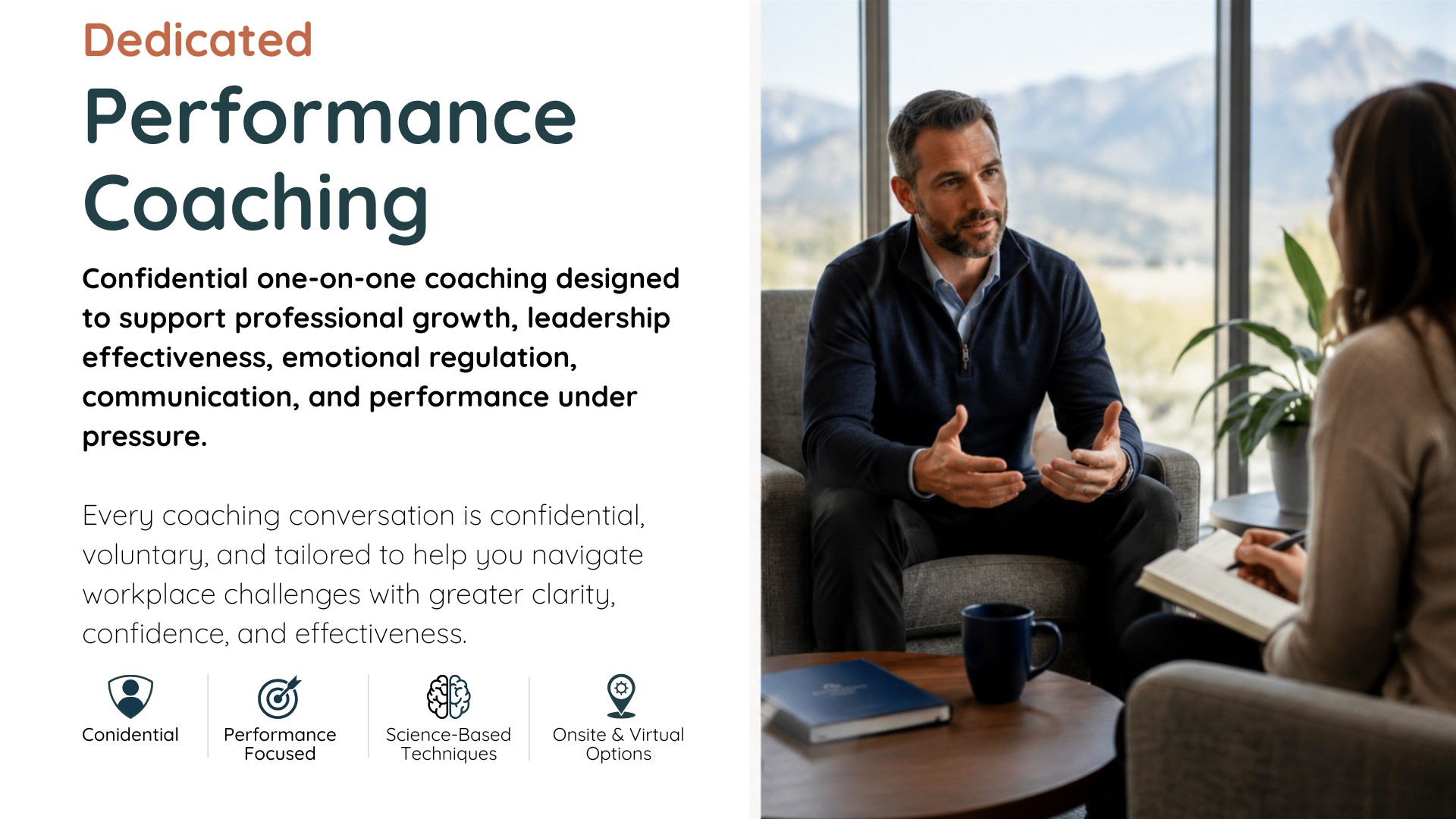
HOW BIG SKY WAY DEDICATED PERFORMANCE COACHING WORKS
What You'll Bring to the Sessions
You'll bring your current challenges, goals, opportunities, questions, leadership responsibilities, and workplace situations.
What Happens During Coaching Sessions
It's simple! During coaching sessions, we'll have a confidential conversation focused on gaining clarity, exploring options, developing strategies, strengthening accountability, and improving effectiveness.
What You'll Leave With
You'll leave sessions with a greater self-awareness, practical action steps, improved emotional regulation, enhanced leadership capability, and increased confidence to act.
WHAT PERFORMANCE COACHING IS
- It is a confidential, professional development process.
- It supports self-awareness, communication effectiveness & emotional regulation.
- It strengthens interpersonal effectiveness & leadership performance.
- It promotes professional growth and performance under pressure.
- Participation is voluntary.
WHAT PERFORMANCE COACHING IS NOT
- It is not psychotherapy, counseling, or mental health treatment.
- There is no diagnosis, treatment, or clinical intervention provided.
- It is not intended to address mental health disorders.
- The Coach is not acting in the capacity of a licensed mental health professional.
CONFIDENTIALITY
All coaching conversations between the Coach and Client are strictly confidential. The Coach will not disclose personal discussions, emotional content, reflections, insights, experiences, or specific session content shared during coaching to the sponsoring organization or any third party without the Client’s explicit written consent, except where disclosure is required by law or where there is a credible safety concern.
CONFIDENTIALITY
All coaching conversations between the Coach and Client are strictly confidential. The Coach will not disclose personal discussions, emotional content, reflections, insights, experiences, or specific session content shared during coaching to the sponsoring organization or any third party without the Client’s explicit written consent, except where disclosure is required by law or where there is a credible safety concern.
What Does a Session Look Like?
Performance coaching is a confidential one-on-one process designed to support professional growth, improve communication and effectiveness, clarify goals, strengthen accountability, and help functional individuals perform at a higher level.
Based on the needs of the employee, performance coaching can move in and out of the three types of coaching at the employee’s discretion.
3 Types of Coaching:
- Traditional Performance Coaching → Everyday workplace performance
- Leadership Coaching & Consult → Strategic leadership and organizational challenges
- Performance Psychology → Deeper personal patterns that influence performance
Regardless of the type of coaching used, employees have the option to implement two science-based interventions: HeartMath® to train and build nervous system regulation and Mind-Body Alignment (MBA) Method™ to transform and heal old wounds. Together, high performers and leaders are equipped with discreet practical techniques to regulate their internal state and perform effectively in moments that matter most.
Data Collection
Though the sessions are confidential, data derived from coaching engagement trends and organizational themes will be aggregated into anonymized organizational metrics. These insights are aggregated and will never identify or be traceable to any individual. Aggregated reporting shall be limited to generalized organizational patterns, operational themes, utilization trends, and non-identifiable developmental observations.
These results will be presented at the Quarterly Review for Senior Leadership, where the anonymized data collections are shared providing clearer visibility into performance patterns, identification of root causes, and targeted recommendations to improve operations and leadership.
Schedule
Wednesdays from 8:00 am to 5:00 pm (8 hours plus 1-hour lunch break). Sessions are 50-minutes in length and location is on site or zoom (see schedule below). Scheduling will be managed by Big Sky Way.
- 1st Wednesday – Helena
- 2nd Wednesday – Bozeman
- 3rd Wednesday – Big Timber & Butte
- 4th Wednesday – Billings
On Call Sessions. Two on-call sessions per location (for a total of eight available on-call sessions per month) will be available for time-sensitive professional situations that cannot reasonably wait until the next scheduled onsite or virtual coaching session. On Call sessions are scheduled directly through Big Sky Way using the designated scheduling process.
Performance Coach Emergency Unavailability. In situations where Performance Coach is unavailable due to illness or other unexpected emergencies, sessions will be rescheduled to the following week on non-Wednesdays to ensure agreed upon coverage.
Informed Consent & Disclosure
This document describes the scope, purpose, confidentiality boundaries, and professional limitations of the performance coaching relationship between Big Sky Way, Inc. (“Coach”) and the participating employee (“Client”).
Download & Sign Consent Form